A BOOK BUILT TO LAST
Made to be
handed down.
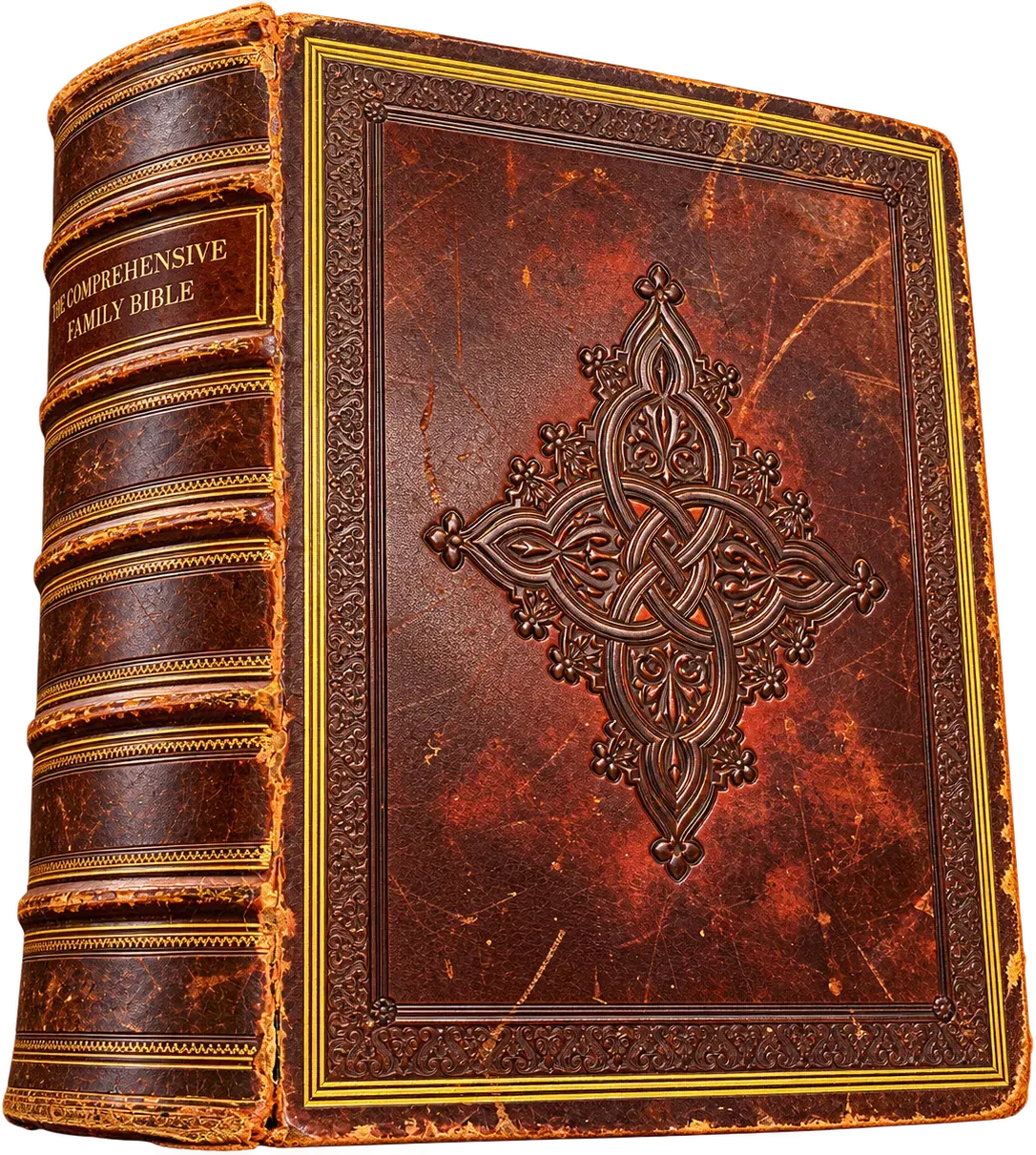
The Victorian family Bible was often the most substantial book in a household, made to be read, studied and passed from one generation to the next.
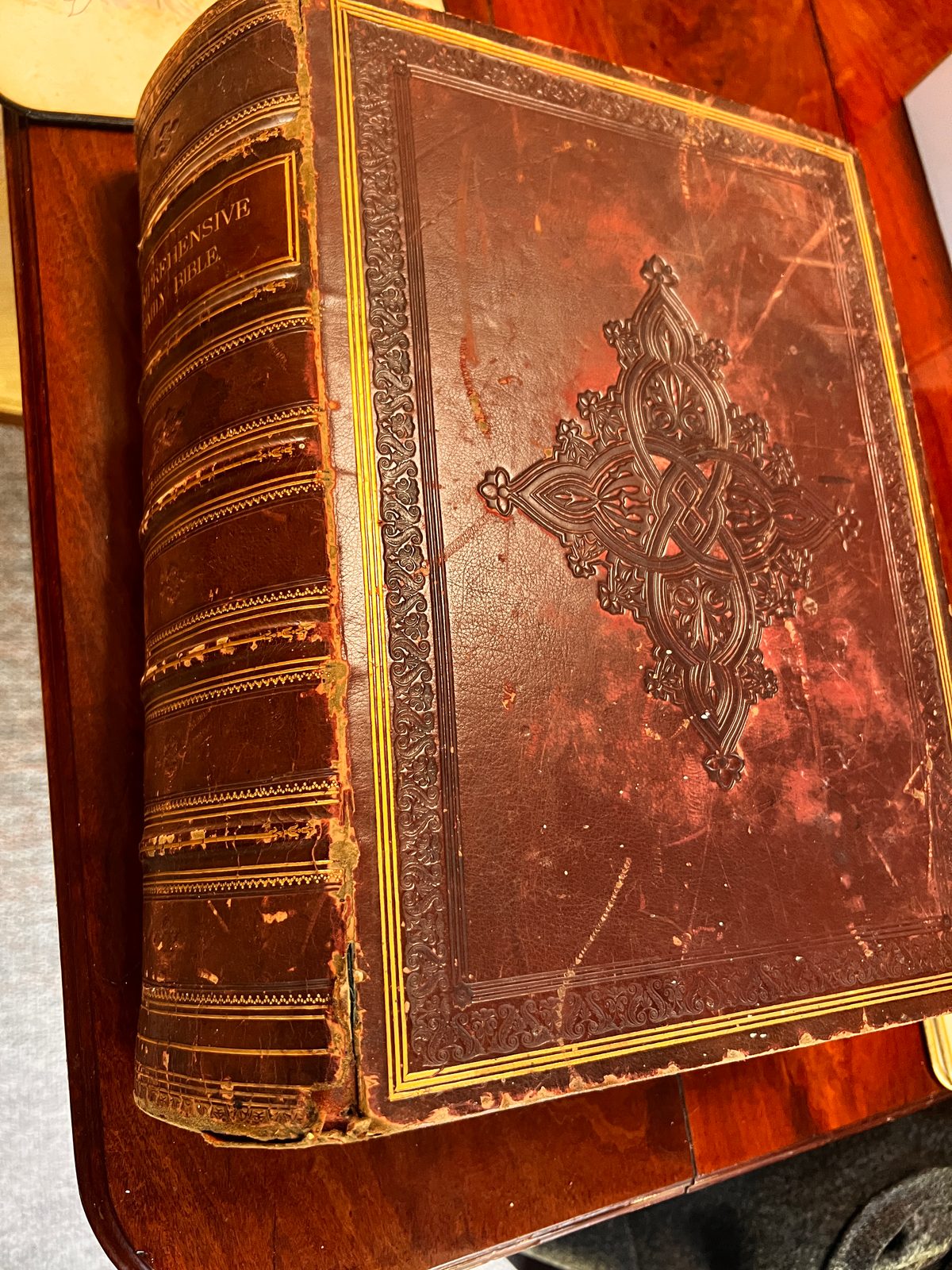
This copy is an imposing volume bound in dark reddish-brown leather, with an embossed central ornament, gilt rules and decorative tooling on the covers, and gilt lettering on the spine.
Inside are the Old and New Testaments with commentary, separately printed engravings, coloured maps and reference tables. Its survival is a physical link to a time when an illustrated book was a real investment in printing, engraving and binding.
 View full size
THE ENGRAVED TITLE
A title page
as artwork.
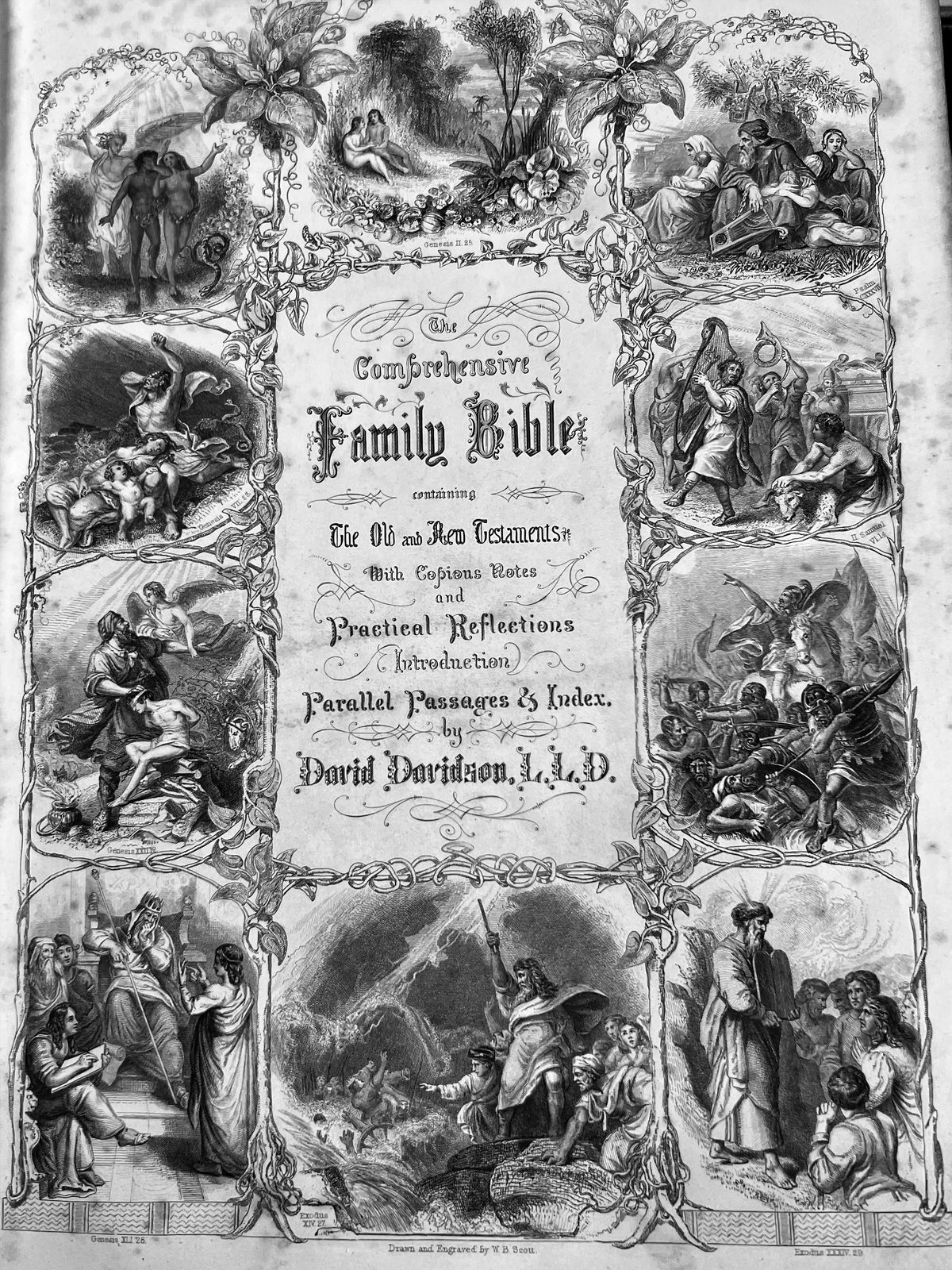
Before the printed title comes an engraved one. Scenes from Genesis and Exodus, David with his harp, Moses with the tablets of the law and the crossing of the Red Sea sit in a frame of twisting vines around the lettering.
At the foot of the plate is the credit “Drawn and Engraved by W. B. Scott”. The book’s own List of the Engravings agrees: Illustrations of Old Testament History, engraved title, painter “Various”, engraver W. B. Scott.
The Comprehensive Family Bible
containing
The Old and New Testaments
With Copious Notes and Practical Reflections
Introduction
Parallel Passages & Index
by David Davidson, L.L.D.
 View full size
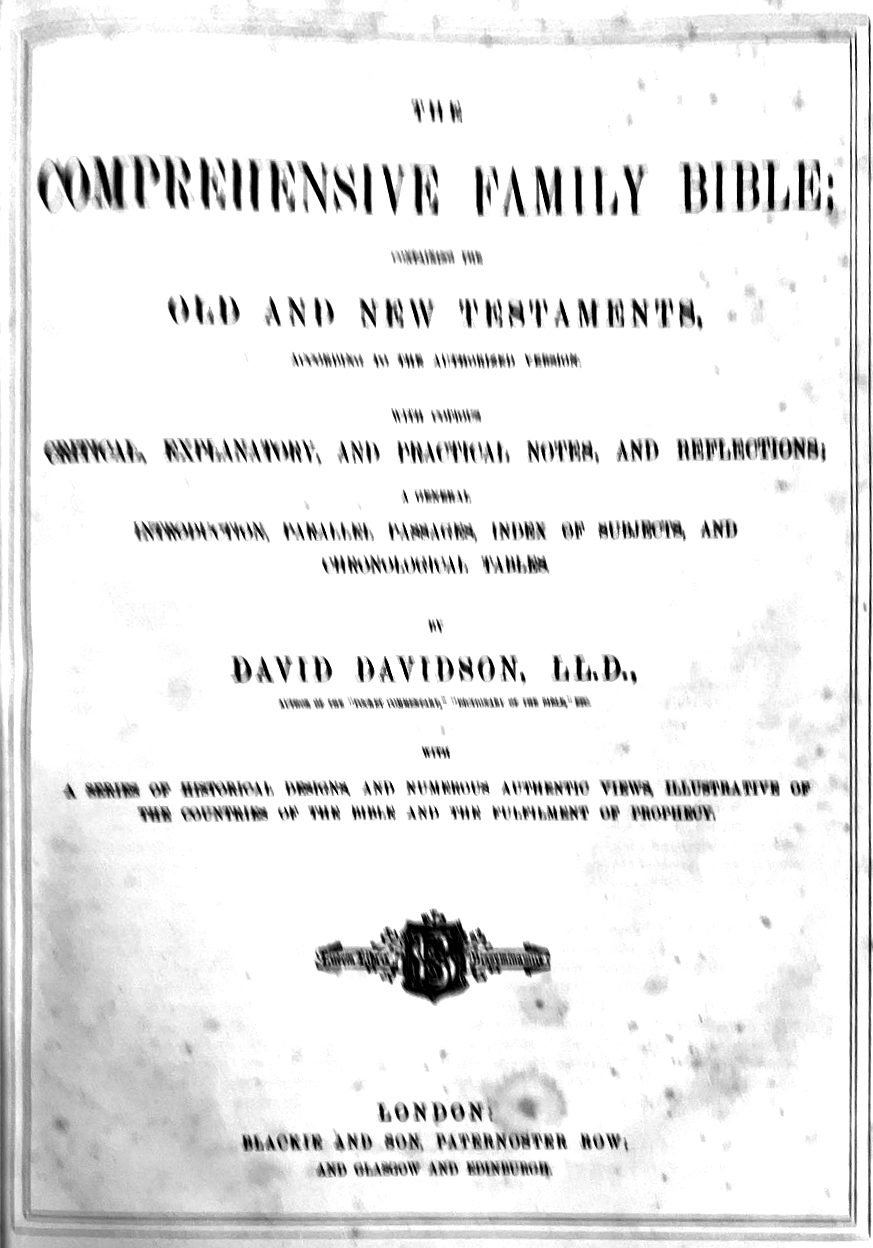
The letterpress title page sets out what the publishers promised. It is transcribed here line by line. Lines in very small type are soft in the photograph and are marked.
- The
- Comprehensive Family Bible;
- containing the
- Old and New Testaments,
- according to the Authorised Version;
- with copious
- critical, explanatory, and practical notes, and reflections;
- a general
- introduction, parallel passages, index of subjects, and chronological tables.
- By
- David Davidson, LL.D.,
- author of the “Pocket Commentary,” “Dictionary of the Bible,” etc. (uncertain)
- with a series of historical designs and numerous authentic views, illustrative of the countries of the Bible and the fulfilment of prophecy.
- London: Blackie and Son, Paternoster Row; and Glasgow and Edinburgh.
There is no date on the title page. The Bible is believed to date from around the 1850s, but the date of this copy has not been verified.
WHY “COMPREHENSIVE”?
A home
reference library.
The title page lists what made the book comprehensive: critical, explanatory and practical notes and reflections; a general introduction; parallel passages; an index of subjects; and chronological tables.
It also promises “a series of historical designs and numerous authentic views, illustrative of the countries of the Bible and the fulfilment of prophecy”. The views of Petra, Baalbeck, Damascus, Tarsus and the seven churches of Asia are exactly that: travellers’ sketches of real places, redrawn by artists such as W. L. Leitch, J. A. Houston and Sam Bough and cut by professional engravers.
With its maps, tables and engraved views, the Bible worked as a reference library for the home, combining religious instruction with history, geography and visual education. See the reference pages and maps.
WHO MADE IT
A Scottish
publishing house.
Four imprints in the book name its makers. Blackie and Son appear with addresses in London, Glasgow and Edinburgh, and the printers are named as W. G. Blackie and Co. of Villafield, Glasgow.
| Imprint, as printed | Where it appears |
|---|---|
| London: Blackie and Son, Paternoster Row; and Glasgow and Edinburgh. | Foot of the letterpress title page |
| Blackie & Son, Glasgow, Edinburgh & London. | Foot of each engraved plate |
| W. Hughes, London. | Corner of the maps |
| Glasgow: W. G. Blackie and Co., Printers, Villafield. | Foot of the Table of the Paraphrases |
Further publishing history is not given here unless the book itself or a reliable source supports it. No print run, exact year or provenance is claimed for this copy.
STILL TO CONFIRM
Open
questions.
- The date of this copy. The title page is undated.
- The New Testament page of the List of the Engravings has not yet been photographed. Until it is, New Testament credits come from the lines printed under each plate.
- The page number of the last page of Revelation, which reads “(14?5)” in the photograph.